Love Duets

Love Duets

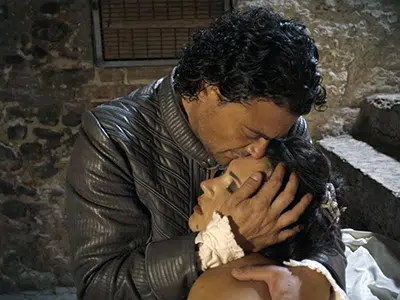
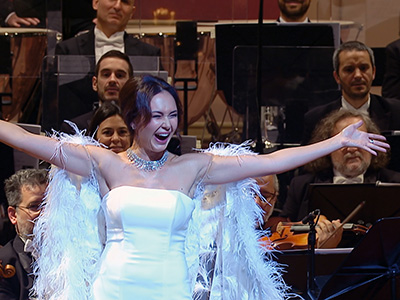
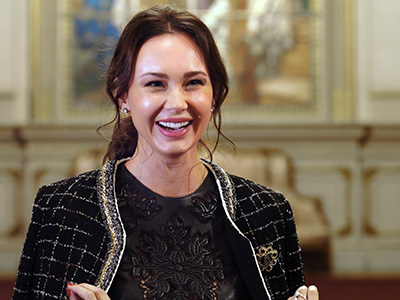
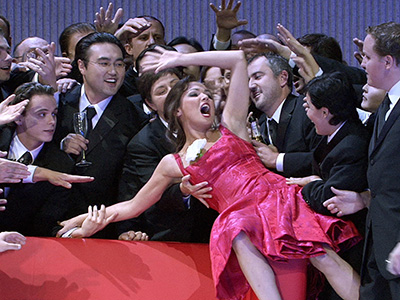
Love Duets | with Sonya Yoncheva and Vittorio Grigolo in the Arena di Verona

A film by Claus Wischmann, WDR/arte, 43 min.

Sonya Yoncheva, Vittorio Grigolo and Plácido Domingo present the most magnificent arias of love by Puccini, Verdi and Gounod in Verona – the setting of the most famous of all love stories: William Shakespeare’s “Romeo and Juliet”.

A concert evening about love, lust and stormy passion. The film shows the final preparations and rehearsals, takes us backstage and presents excerpts from the concert.

Oil Promises

Oil Promises

Oil Promises

A film by Elke Sasse, Andrea Stäritz and Ebele Okoye, 90min., Ghana, 2020

You are currently viewing a placeholder content from Vimeo. To access the actual content, click the button below. Please note that doing so will share data with third-party providers.

More Information

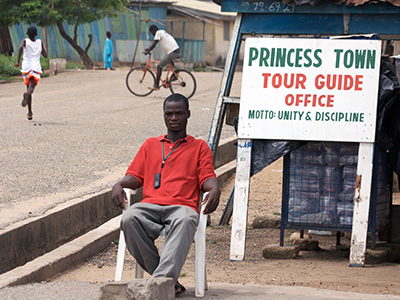
When oil is discovered in Ghana in 2007, the dreams of local communities begin to soar. Nigerian animation artist Ebele Okoye has high hopes of her own, above all that Ghana can avoid the fate of the Niger Delta, where the oil heralded disaster. Perhaps the promises will actually be fulfilled this time and the black gold will bring progress and a more modern life for the underdeveloped villages: paved streets, electricity, maybe even jobs. When the drilling begins in 2010, she resolves to observe developments more closely.

By 2010, Ghana has become an oil country. Offshore drilling is underway, international oil companies are seeing rising revenues and investors are presenting plans to industrialise and develop the former “Gold Coast”. Where colonial powers once staked their flags, small fishing villages without water or electricity are now waiting for their share of the spoils. The entire region is poised before transformation and the villagers dream of a better future:

Farmer Adom clears the bush for the construction of a new refinery as well as modern houses with bathrooms for himself and the other villagers.

Teacher Matthew is elated about plans for a luxury hotel. He wants to show tourists around the ancient fort, which was built by the Germans.

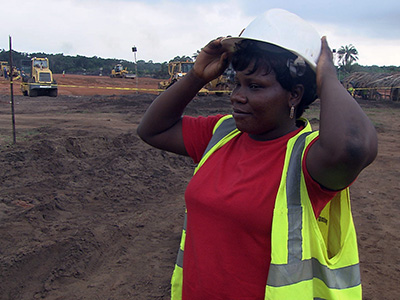
Gifty, a hawker, hopes to operate the bulldozers that will lay the foundations for a gas processing plant in her village.

Some years later and the bulldozers have arrived in Gifty’s village, but they are operated by Chinese workers. Other villages continue to wait for the promised developments. We encounter them again in 2014 and 2019, and still they wait. And as the bush reclaims the cleared land, the dreams of the communities diminish.

OIL PROMISES is a case study in globalisation from the perspective of those who never stop dreaming that they will see a share of the prosperity. Throughout, it becomes clear that the high-tech industry is operating in a parallel universe and is ruthlessly exploiting the natural wealth of their home region.

Over a period of 10 years, filmmaker Elke Sasse and journalist Andrea Stäritz have documented the developments in three small villages on the Western Coast of Ghana. The result of their work is an emotional film about people who dream of benefiting from incredible riches.

Animation artist Ebele Okoye includes her personal point of view and uses vivid animations to provide a commentary. As a citizen of a nation hit particularly hard by the oil curse, she takes a critical look at the activities and assurances of international oil companies, investors and politicians, and questions why, against all the evidence, the locals still take these promises at face value.

What happens when a number of small African fishing villages are pulled in and overtaken by the forces of globalisation? Could this story mirror those of the past, where profits disappear and the fishermen are left to pick up the debris?

TV Broadcast dates and times | DW

Magic Moments of Music– Arthur Rubinstein: Farewell to Chopin

Magic Moments of Music– Arthur Rubinstein: Farewell to Chopin

Magic Moments of Musik | Arthur Rubinstein: Farewell to Chopin

A film by Anne-Kathrin Peitz, ZDF/arte and C Major Entertainment, 43 min., 2021

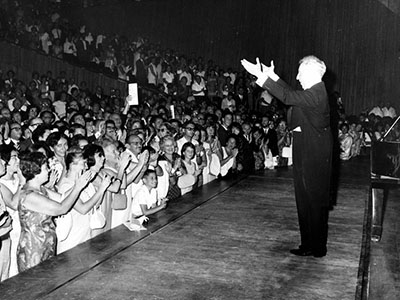
In April of 1975, a piece of music history is made in London’s Fairfield Hall: the legendary pianist Arthur Rubinstein, who is gradually going blind, wants to leave a legacy to the world. Chopin’s Second Piano Concerto has accompanied him throughout his life. At Fairfield Hall, Rubinstein brings it to life a final time in his warm-hearted, lyrical style.

For this occasion, Arthur Rubinstein returns to London, where he made his debut 63 years earlier. Now 88 years old, he is a living legend, on a par with the great composers like Rachmaninoff and Stravinsky. It is the finale of a lifetime of achievement and a grandiose performance from a past master.

Rubenstein dominated the world stage for three quarters of a century and lived life to the fullest as a connoisseur, globetrotter and notorious womaniser. Although he claimed to practice as little as possible, he would go on to become one of the most important pianists of the 20th century and described himself as “the happiest man I ever met in my life”.

In Farewell to Chopin Daniel Barenboim confesses that at the age of just 14, he smoked his first cigar and drank his first vodka together with Rubinstein. His constant companion Annabelle Weidenfeld recalls his incredible charm, and youngest daughter Alina Rubinstein remembers the charismatic but often absent father whom she “wouldn’t trade for anyone in the world”. Rarely seen archive recordings provide fascinating insights into the family life of the Rubinsteins, while the master at the keys also has his own say.

No audience is present for this legendary concert recording – the performance is exclusively for the cameras. Together with the London Symphony Orchestra under conductor André Previn, Rubinstein is every bit the lustrous piano icon: upright and elegant in his tailcoat, he is enthroned at his instrument. The maestro’s playing is generous, luminous, supple, rhapsodic. Seemingly effortlessly, he evokes his singing and breathing “Rubinstein tone” that is venerated to this day. At almost 90 years of age, this exceptional musician and interpreter of Chopin is as captivating as ever: he is buoyant, a little mischievous. His audience always loved him for these qualities – and he loved them back.

Aida Garifullina at Teatro Colón – My Argentinian Dream

Aida Garifullina at Teatro Colón – My Argentinian Dream

Aida Garifullina at Teatro Colón – My Argentinian Dream

A film by Tilo Krause and Isabel Hahn, ZDF/arte, 43 min.

You are currently viewing a placeholder content from Vimeo. To access the actual content, click the button below. Please note that doing so will share data with third-party providers.

More Information

We join soprano Aida Garifullina during a milestone in her career, on the stage of one of the world’s most beautiful opera houses: the Teatro Colón in Buenos Aires. Accompanied by the musicians of the Orquesta Filarmónica de Buenos Aires under the direction of Argentinian conductor Carlos Vieu, she slips into the roles of Norma, Juliette, Rusalka, the Snow Maiden – and into tailor-made haute couture robes to match. In Buenos Aires, Aida Garifullina plunges into a completely new world, and for the first time in her life she sings and dances the tango.

In Argentina, Aida Garifullina will be coming up against a critical audience that she must first win over. Alongside well-known arias such as “Je veux vivre” from Romeo and Juliet by Charles Gounod and “O mio babbino caro” by Giacomo Puccini, Aida has many surprises in store for the audience, including the aria “Procession of Tsar Berendey” from Nikolai Rimski-Korsakov’s opera The Snow Maiden, which is largely unknown in Argentina. Aida is committed to introducing this aria from the Russian composer to her new audience, whom she hopes to infuse with her own enthusiasm. And she succeeds.

The second surprise is in fact a premiere: Aida has never before sung the role of Mimì from “La Bohème” by Giacomo Puccini on a large stage and accompanied by an orchestra. In the Teatro Colón, Aida rehearses the great aria “Si, mi chiamano Mimì” for the first time. In the end, the soprano puts all her heart and soul into the performance. As an encore, she sings the popular “Por una cabeza” by the tango composer Carlos Gardel and lyricist Alfredo Le Pera. Everyone in Buenos Aires knows the melody and the lyrics to this song, and the singer soon has the audience singing along.

Aida Garifullina is in Argentina for the first time and is keen to get a taste of the tango scene. She visits a milonga and is shown some steps by a professional dancer. “I immediately had a hundred questions for him. OK, which steps? What do I need to do here? And should I look at you here? – Please Aida, just relax and breathe. And trust me. I said: OK, I trust you.”

A few hours later, Aida swaps her high heels for brand new tango shoes, which she is wearing when she steps onto the stage. They are a perfect match for the sublime dresses from the Russian Humariff collection, which were designed exclusively for the singer. On the occasion of her performance at the Teatro Colón, Aida combines these dresses with jewellery from the Santino jewellers in Buenos Aires – fireworks for the eyes and ears.

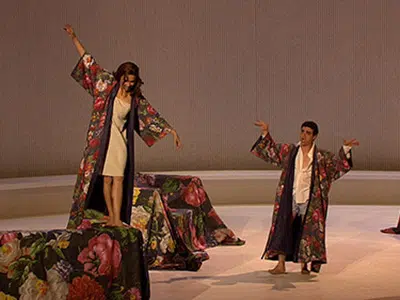
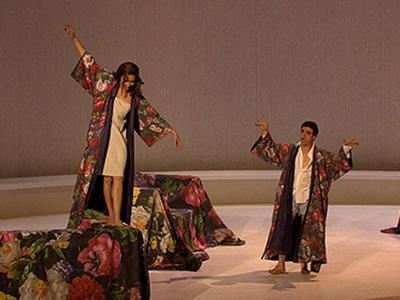
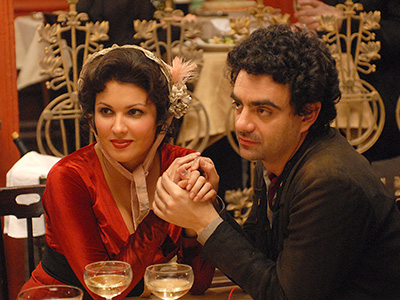
Magic Moments of Music – Anna Netrebko & Rolando Villazón sing La Traviata

Magic Moments of Music – Anna Netrebko & Rolando Villazón sing La Traviata

Magic Moments of Music – Anna Netrebko & Rolando Villazón sing La Traviata

A film by Anaïs Spiro, ZDF/arte und C Major Entertainment, 43 min.

You are currently viewing a placeholder content from Vimeo. To access the actual content, click the button below. Please note that doing so will share data with third-party providers.

More Information

The performance of La Traviata at the 2005 Salzburg Festival drew attention from all over the world: it is not the first time on stage together for Anna Netrebko and Rolando Villazón in the leading roles – but it is here in Salzburg that they finally rise to superstardom. Each are brilliant on their own, but under the direction of Willy Decker, they shine above all as a couple, playing to the fantasies of the audience. Opera stars had never before been so up-close and personal, and had never been so present in the media. Previously unseen rehearsal scenes and interviews with Anna Netrebko, Rolando Villazon, Thomas Hampson and Willy Decker bring this magic moment of music to life.