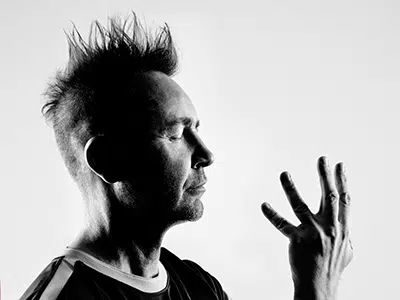
Magic Moments of Music | Nigel Kennedy & The Four Seasons

Magic Moments of Music | Nigel Kennedy & The Four Seasons

Magic Moments of Music | Nigel Kennedy & The Four Seasons

A film by Silvia Palmigiano and Isabel Hahn, ZDF/arte and C Major Entertainment, 43 min., 2022

In 1989, Nigel Kennedy’s recording of Vivaldi’s The Four Seasons causes a turmoil in the world of classical music. The press call the musician the “punk violinist” while others treat him with scorn. However, the record goes on to sell more copies than any other classical album before or since. Kennedy succeeds in transcending the reservations of an audience that considers classical music too elitist or aloof. The film tells of the incredible rise of an outsider into superstar and of a Vivaldi interpretation that has achieved cult status.

You are currently viewing a placeholder content from Vimeo. To access the actual content, click the button below. Please note that doing so will share data with third-party providers.

More Information

When Nigel Kennedy presents his vision of a new classical album to the record company EMI, he is met with broad scepticism. Certainly, with his wild hair and an outfit that mixes punk, gothic and new wave, he’s far from the typical classical musician. But manager John Stanley senses an opportunity: “If Kennedy is permitted to be who he is, you could sell millions of records.” And he’s proven right.

The film takes viewers back to 1989 when Kennedy and the English Chamber Orchestra shook up the music scene with their recording of Vivaldi’s The Four Seasons. With daring and verve, Kennedy appeals to an audience that was otherwise averse to classical music, resulting in album sales of over three million and an entry in the Guinness Book of Records.

Early on, the protege of Yehudi Menuhin stands out as a rebel: in the day he studies at the renowned Juilliard School and at night he plays in the New York jazz clubs and learns the art of improvisation, among others from Stéphane Grappelli.

Kennedy recalls: “The classical world felt like a straitjacket. I had to change something or else I had to get out. There was nothing to lose.” During the recording of The Four Seasons, he strives to free himself both from historically informed performance and the Russian School of playing. He seeks out and finds an interpretation that is inarr keeping with the times. With his playing style and arresting appearance, he breaks with the conventions of the classical concert business. The controversy is even discussed in the UK Parliament.

In the concert recording – filmed in the manner of a pop concert – the London audience sits at the edge of the stage in jeans and jumpers. The outfits of the orchestra musicians and the stage lighting change depending on the season. Star violinist Maxim Vengerov tells us what is revolutionary about Kennedy’s playing, and fashion designer Esther Perbandt gives her own view: “He’s an individualist. He doesn’t dress like this to market himself.” Nigel Kennedy says of himself: “I can only be who I am. And that’s how I am.”

With his groundbreaking recording, Kennedy helps young musicians to question the limitations and precedents of the classical music world and he pushes the door wide open for an audience to discover Vivaldi’s famous music.

Apennine Mountains – The Wild Heart of Italy

Apennine Mountains – The Wild Heart of Italy

Apennine Mountains - The Wild Heart of Italy

A film by Kristian Kähler and Silvia Palmigiano, 2x43 min, ARTE 2021

The Apennines are the backbone and soul of Italy in equal measure. These high and low mountain ranges traverse the Italian mainland, alternating from north to south. The many historical sites along the way help define the country as a whole, as does the wild and impassable nature. There are many national parks, home to rare species such as the bee-eating red-backed shrike or the nearly 500 Marsican brown bears. The Italian shepherding tradition has left a strong mark on the cultural landscape of the Apennines. Ancient traditions, picturesque places and living history can all still be found here. Locals call the Apennine Mountains “L ‘Italia minore” – Little Italy.

If you want to understand Italy and its culture, you don’t have to go to Rome or Milan. A journey through the serpentine roads of the northern Apennines is enough to understand where the true heart of Italy beats: right here – in the green forests, the abandoned villages and the rolling hills.

The Apennine mountain range stretches from Liguria across the Italian boot to Calabria at the tip of the boot. Yet the mountain region between the cultural cities of Bologna and Florence is known to only a few.

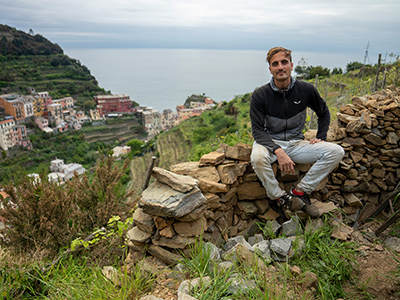
20-year-old Andrea Barrani dreams of producing his own wine right here – on the steep slopes of the Cinque Terre.

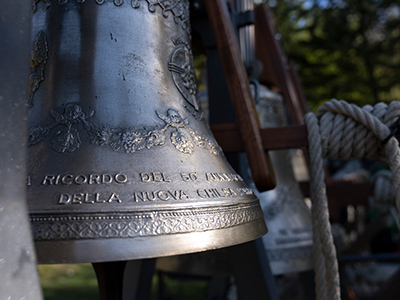
Shepherdess Cinzia Angiolini has also found happiness in the Apennines: she breeds the local Zerasca breed of sheep. Old traditions are preserved in the Apennines because there are people who maintain them – like the bell ringers of Monghidoro.

Young Federico Mezzini still struggles with the 400 kg bells, but he is confident that he will soon be able to play a concert.

Laura Sbaccheri has spent her whole life doing without her dream: She always wanted to ride a motorbike. A stroke of fate prevented her from doing so. Now, in her late 30s, she has finally fulfilled her dream: She rides on the Mugello racetrack at 250km/h and enjoys the thrill.

The journey along the northern Apennines ends in Umbria. Here, geologist Andrea Mazzoli shows on mountain bike tours what spectacular secret lies hidden in the million-year-old rocks.

The Apennines are considered the backbone of Italy – a world of its own with much to discover.

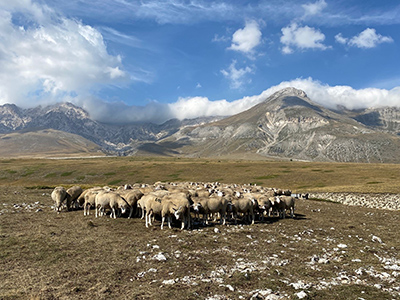
The second part of our series is dedicated to the Southern Apennines. The journey begins on the Gran Sasso, at the almost 3,000-metre Corno Grande – the highest point of all the ranges. The landscapes of Campo Imperatore have been shaped by sheep breeding for centuries. Here, Pastore Abruzzese shepherd dogs protect the sheep from attacks by wolves.

Further south, brown bears emerge from the wooded heights to roam the village of Villalago. The people of this picturesque community have become accustomed to the visits from the Marsican bears. Researchers are studying these endangered animals and working to preserving the population.

Further south in the town of Melfi in Basilicata, falconers maintain the tradition of breeding birds of prey, practised here since the High Middle Ages. Stauferkönig Friedrich II. Friedrich II, Emperor of the Roman-German Empire in the 13th century, was an enthusiastic falconer and wrote a still important book ‘On the Art of Hunting with Birds’.

In the southernmost tip of the toe of Italy, the Apennines surprises with sequoia trees and deep green forests, contradicting assumptions that Calabria is only hot and dusty.

Here, after 1500 kilometres, the journey through the Southern Apennines comes to an end.

Death in the Baltic sea

Death in the Baltic sea

Death in the Baltic sea

A series by Rikke Detlefsen und Jesper Clemmensen, 4 x 25 min, MDR 2021

Part 1 – The Village
Part 2 – The File
Part 3 – Go West
Part 4 : East meets West

What makes a person try to flee across a hostile sea in a most unsuitable vessel, risking – and actually sacrificing – his own life and the lives of those he loves the most? The answer very much depends on the perspective of the person trying to find some kind of meaning in such an horrific incident. Why did they flee? What went wrong? And Who is to blame? These questions look quite different from the two sides of the Iron Curtain – even today.


The escape route from the GDR to the West across the Baltic Sea has been widely overlooked, even though the escapes were no less dramatic and the ressources and methods used by the regime to prevent them were substantial. More people died here, than in escapes across the wall and the border in Berlin. 

One story was the most tragic and incomprehensible of them all: The deaths of two young couples and a small child on September 10, 1979 outside a campground at Nonnevitz on the Holiday Island of Rügen. This was the single “Republikflucht”-incident throughout the history of the GDR that demanded the most victims but very strangely never has been documented.

The background, facts and consequences of the fatal escape attempt of Ulf (30), Renate (29), Lutz (24), Manuela (19) and tiny Ines (2) have been a painful mystery to their next of kin for decades. Trying to solve it brings several unexpected turns of events that touch upon the fundamental grievances of the Cold War years in the divided Germany. And it turns out to be a tale of longing, love, hate and misconceptions between three families, and between the GDR and the BRD. 

Walid Habash

Walid Habash

Walid Habash

Digital Media Designer
Walid Habash Azubi Mediengestalter Bild und Ton

Contact:

+49 30 44 03 169 – 35
walid[at]schnittlauchpostproduktion.de

Walid first came to Berlin Producers as an intern and then began his training as a media designer for images and sound in 2018. After successfully completing that, he stayed on and now assists with all the steps of the postproduction process.
He has always had a passion for music and is also working on his career as a musician.

Lily Küntzle

Lily Küntzle

Lily Küntzle

Editorial Office, Producer
Isabel Hahn Editorial Trainee

Contact:

+49 (0)30 44 03 169 – 11
lily.kuentzle[at]sounding-images.de

Lily Küntzle has a background in musicology and had previously worked mainly in festival organization. As an assistant media officer at the Salzburg Festival, she then came into intensive contact with concert streaming, ultimately leading her to Sounding Images. Here, she started as a trainee in 2021. Since 2022, she is a producer and part of the editorial office. Lily grew up in Berlin, the USA, and Vienna.

Filmography

Author/Producer/Assistant (selection)


2024

MAGIC MOMENTS OF MUSIC – Series (52 min, ZDF/ARTE, C Major, Unitel, EuroArts)

Mischa Maisky plays Tchaikovsky (52 min, NDR/ARTE, C Major)

Celebrating Christmas | With Benjamin Appl, Elsa Dreisig and the Regensburger Domspatzen (65 min, BR/ARTE)


2023

„MAISKY & JÄRVI“ | Mischa Maisky – Zum 75. Geburtstag (96 min. ARTE Concert)

Music ex machina – Artificial Intelligence in Classical Music (52 min. WDR)


2022

7 Lives of Music – The Kanneh-Mason Family (60 min. ZDF/3sat)

Pierre-Laurent Aimard plays Olivier Messiaen (36 min. ARTE Concert)

On Tour with Mozart – Felix Klieser and the Bournemouth Symphony Orchestra (43 min. WDR/Arte)

VIKTOR ULLMANN: Die Weise von Liebe und Tod – Aufnahmen des Jewish Chamber Orchestra Munich in Theresienstadt (Onlineformat)


2021

The Lucky Tenor – José Carreras turns 75 (30/45 min. BR/WDR/SWR)

Happy Birthday, Giora Feidman (70 min. ZDF)